Showing posts with label Random Stuff. Show all posts

Wednesday, August 20, 2025

An Amish farmer's struggle with drought

New York Amish farmhouse drought August 2025
“We need the rain."

I’m talking with Eli, the Amish owner of a farm in northern New York, not far from where my grandfather was born. At 11 am, it’s already 88 degrees, with not a cloud in the sky. It’s been so dry this month that the entire county is under a no-burn order. The fields of corn look parched.

St Lawrence county burn ban
 Eli is in his late 30s. He looks like actor Jesse Plemons, except he’s wearing a blue work shirt and trousers and no shoes. Eli’s straw hat has seen a lot of use, and at one point was repaired with a squiggle of pink yarn.

The fruits and vegetables in his family’s roadside stand look fresh. A box of green beans and a cantaloupe cost $1 apiece. A pint container of pickling cucumbers is $2. I offer $3 for a dozen enormous eggs, but he’ll only take $2.50. He says if the melon isn’t good, to bring it back and he’ll give me another one.

I point at the other melons on the shelf. “Don’t those need a lot of water?” I ask.

“We fill up a tank from the well every day, so the water is warm,” Eli explains. “Then we water the front garden after dinner.”

Amish farm drought
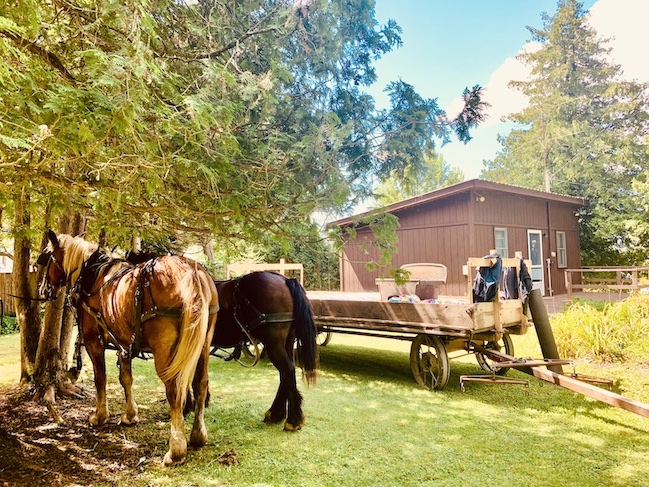
Nearby, a ewe and her lambs urgently bleat from their small piece of shade, an open-sided loafing shed constructed of sheet metal. Beyond lies an old wooden barn. Ancient farm equipment is arrayed outside: a manure spreader, a stalk chopper, and wagons that might have been featured in the 1908 Sears catalogue. I spot two of Eli’s barefoot sons wrestling a giant bale off of a hay wain.

Eli and his family are living a life not much changed from the 1800s. Everyone reading this has parents or grandparents or ancestors further back in time who tilled the land. They would surely recognize the scene: a sprawling rural property with a farmhouse, barn, and a dozen outbuildings. Farm animals. Sturdy work clothes and dresses hanging from a clothesline off the porch. Horse-drawn farm equipment. A workshop to repair furniture and tools, and make things that can be resold.

amish Farmhouse clothesline
Our ancestors paid close attention to the weather, and feared extended periods of dry weather. A lack of water could ruin a harvest, or even cause a farm to go bust. In the 1930s, the Dust Bowl led to millions of people migrating out of the Great Plains, mostly to California and other West Coast states. 

Eli is likes to chat, but there is concern in his voice. He and his wife have 7 mouths to feed. If the weather doesn’t cooperate, they will harvest less corn and hay. In recent years, there have been more hot days and long stretches without rain. Winters have been milder. 

New York drought monitor september 2025
Around Eli’s farm are yellowing fields. Selling produce and repairing furniture brings in a little cash, but it’s the crops and pastureland that are the foundation of the family’s income. Hay has been harvested early from one field. The stacks look shorter than usual. 

Amish hay harvest baler and haystacks
And then there is the land itself. “The soil is not deep here,” Eli complains. “My plow often hits rock.”

But it was cheap. Around here, farmland costs just $1,000 to $3,000 per acre. It’s not just because the soil sits on a shelf of rock 18 inches down. The population of northern New York has been in decline for decades, and few English families stick with farming.

Eli and many other local Amish were originally from Ohio. “There was no more land there,” Eli explains. “You needed millions of dollars to buy a farm.” Even if it were a sale within his Amish community in Ohio, the minimum price would be $6,000 per acre, he says.

I glance at my phone. “Forecast says a 65% chance of rain tomorrow,” I tell him.

“Really?”

“Yes, around midday,” 

“Let’s hope,” he says.

Monday, November 04, 2024

The Price of Amish Butter

Amish children northern new york
In rural areas across the country, Amish farmstands are a common sight. On recent visits to northern New York, where one branch of my family comes from, we’ve been able to find seasonal produce such as corn and beans and squash, as well as year-round items like raspberry preserves and eggs.

But not butter.

Amish farmstand northern New York
Last week, I asked our regular farmstand operators, the Zooks, if they had any. The teenaged daughter ran barefoot back to the house to ask her mom, but came back with the news that no, they don’t have butter because they sell all of their dairy to the local cooperative. “Try the Amish family that lives on Wharton Road,” the girl said. “They don’t sell to the association."

A boy at the first Amish farm on Wharton Road was playing with a homemade wooden crossbow in the front yard when I pulled up. A friendly border collie mix with burrs in its matted fur ran up to greet me.

I asked the boy if they had any butter. He went inside to ask. “My sister says no,” he reported. “But go down the road, you’ll pass two English houses, and then there is an Amish house on the left, they may have some.”

His parents weren’t home. They had gone with the ambulance that had just taken their youngest son, not yet three, to the hospital with a chest injury. A piece of furniture had fallen on him in his father’s woodshop. One of the other children had run to the nearest English neighbor to ask them to call 911. The local volunteer fire department quickly responded. 

Amish farm wagons
There is a hard edge on these remote country roads, where the Amish subsist much as our ancestors did 200 years ago. Horses are not for riding or racing. They are beasts of burden, pulling antique plows or the black carriages the Amish use for trips into town. There are no phones or automobiles or refrigerators.

Life revolves around family, faith, and the rhythm of the farm. It starts early. Children help out on the farm beginning when they are 5. They attend their own schools through 8th grade. Full-time agricultural and household labor starts at age 14 or 15. A few summers back, two teenaged Amish boys came to take away some furniture and a cast iron stove that must have weighed at least 200 pounds. The Amish teens came with the biggest dray wagon I have ever seen, and handled the job without a word of complaint. 

Amish labor northern new york
Further up the road, I found the other Amish household. The farmstand was closed and no one was about, but I could see laundry hanging outside the clapboard house, rocking in the light breeze. The family dog on the front porch barked furiously. A pale face appeared in the window brightened by the fall sun. I waved and smiled. It was the wife, who opened the door and greeted me. Her name as Amanda. She seemed surprised when I asked for butter, but said she could sell me some.

“One of your neighbor’s daughter’s sent me here,” I explained. “The Zook’s daughter. She says you aren’t in the dairy cooperative, and might have butter to sell.”

“We used to belong,” Amanda said with a resigned sigh. “It seemed good at first, but the prices …”

“Not enough?” It’s well known that milk prices are falling

“No, not enough.” She went inside. Her teen daughter appeared and started to take laundry off the line. Nearby, a little boy of about three with a bowl cut and wearing blue overalls and a brimmed hat silently watched me. As the girl finished, she said something in German dialect to the boy. The only word I recognized was komm, “come.” The boy followed his older sister inside.

Amanda returned with a pound of butter, wrapped in plastic. 

“How much?”

“Oh, $2 or $3.”

I gave her $3. Later, when we tasted it, we knew it was the best butter we have had in years. 

Amish butter homemade
 “What will you do now, if you can’t sell dairy to the cooperative?”

“Well, we sell eggs, and on Friday I make donuts to sell,” Amanda said. “My husband does carpentry, and he talks about making seat cushions for boats this winter, but his stitchwork is not that fine.” She grinned.

I thanked Amanda. We will be back in the spring.


Friday, August 09, 2024

Boston-area 1980s videos from the WGBH archives

A few years ago, I stumbled upon a quirky social media account operated by a public broadcaster in Boston, GBH Archives (aka WGBH Archives). It has proved to be a fountain of 1980s nostalgia.

The GBH Archives Twitter and Facebook accounts provided a daily dose of old videos from the vault, many from the 1980s. Street scenes (Facebook). Storms (Twitter). Shoppers (Twitter). High school students (Facebook). Snowstorms. Interviews with locals, from a “Celtics superfan” to our former governor, Michael Dukakis. Bettors at a chariot race (yes, this was a thing):

Much of the shared clips are B Roll - supplementary footage used to provide context or establish the background of a news story.

For instance, “Back seat drive along Memorial Drive and Mass Ave Bridge in April, 1984” shows the view from the back seat of a car driving around Cambridge and Boston while the driver fiddles with the radio.

It’s utterly mundane, and utterly delightful to watch. I’m clearly not the only one, as such clips typically garner hundreds or thousands of likes and shares.

Why do we feel nostalgic when looking at 1980s videos of street scenes, hairstyles, and automobiles? Because it reminds us of our youth. It shows us how cities and towns have changed, for better or for worse. We hear accents that have faded, and performers that are no longer with us. The footage brings to light the places and people and music and fashions and trends that made us who we are.

It’s fun to find these repositories. We salute the media archives, history societies, and museums that make an effort to preserve and share them. This often means resurrecting obsolete technology formats (see "Digital reality check: CD-ROM database of WW2 airmen can only be opened on Windows 98").

But they are constantly under threat, as the recent deactivation of the MTV News archive shows. Thousands of hours of interviews with artists and producers dating from the 1990s were taken offline as staff were laid off. Some of it may be stored on the Internet Archive, but much of it is gone forever.

Nostalgia can be a huge aid to genealogy research, whether the goal is to gather information or family stories.

 I was reminded of this when researching a maternal great-grandmother, and an old print archive turned up - the “Old Timer's” column in the March 1933 issue of the Canton Commercial Advertiser in Canton, New York, reminiscing about attending grade school where my great-grandmother was his teacher … in the 1880s!

Saturday, September 09, 2023

The games we played as children: Relievio

It's now early September. Hearing the crickets at dusk takes me back to the warm late summer evenings of yesteryear, and the sounds of neighborhood kids playing outside. 

Growing up, what were the games you played with your neighbors or siblings? Hopscotch? Stickball? Jumprope? A list of children's games is endless. But I wanted to mention a special one: Relievio. 

From age around the age of 8 to 12, this was a favorite game in our neighborhood. Relievio was a simple game, a cross between hide and seek and capture the flag, but spanned all of the properties on the street, including back yards. You needed at least a half-dozen kids to play, who were divided into teams. There was also a "jail," but the captured kids could be freed by a teammate. There were special phrases and calls, including "Ollie Ollie in come free." 

We would play after school until it got dark or it was time for dinner. On a warm night, we would go home for supper, but then come out again to play until twilight or our parents called us in. The cries of the game and shouts of glee when someone was tagged echoed throughout the neighborhood and then faded as everyone drifted home. As darkness fell, the crickets started their own calls. The block fell silent until the next day. 

I always assumed that one of our cleverer or more social friends made up Relievio, or perhaps learned of it from other kids in our town. Recently I learned that Relievio actually has a long tradition, going back to the 1800s and spreading across at least two continents under various names. The origins are obscure, but it seems to have come from Britain. The game-ending phrase that I heard as a child - "Ollie Ollie In Come Free" - was likely "All ye, all ye, in come free" at some point. We had no idea! 

Nicole grew up on the other side of the world and never heard of Relievio. But growing up, she and her siblings and friends had their own games and traditions. Every group of children did, no matter where they lived, or when they lived, as this Breughel painting shows:

Remembering these games now brings a smile to our faces!

As for our own children, our teenage son never heard of Relievio. It's sad, but it's not the first gaming tradition to fade away. I remembering hearing about kick the can, and would find scuffed marbles in the school playground, but never played these games myself - they were the domain of an older generation of children.

But other games live on. Our son played some of the same games that we did 40 or 50 years ago, including touch football and run the bases. In the winter, he went sledding with his friends. Both of our kids were enthusiastic Halloween participants through middle school. These and other childhood traditions will live on ... or perhaps be replaced by something new.

Friday, March 17, 2023

The Amish come for furniture, and how to age a dovetail joint

Last summer, I went to northern New York, to work on a construction project on a family property and blog about genealogy and family history when I could. Here is an anecdote that relates to antique furniture and a visit from an Amish family.

We are demolishing an old structure. There are lots of items to give away, as well as a smaller number of special things we want to keep for the new cabin that will be built on the site.

We have already given a wood-burning stove made of iron and several beds to a local Amish family, whose two middle sons, aged 18 and 19, loaded it up on the biggest horse-drawn wagon I have ever seen:

Amish taking furniture
I was about to give away a chest of drawers to them. It's a piece of so-called "brown furniture" that is well made but not very popular nowadays.  

“Don’t give it away," my parents said. "It’s a nice piece of walnut furniture with dovetail joints.”

That interested me. Dovetail joints are an old-fashioned method of manufacture. It went out of style 150 years ago, but furniture made this way is renowned for quality construction.

I looked on the outside of the chest and couldn’t see any dovetail joints.

My father took out one of the drawers and showed me. I couldn't believe how small and fragile they looked, but they had held together this chest of drawers since sometime in the 1800s!

dovetail joint antique furniture
“The smaller the dovetail, the older the piece,” my father said. They are indeed tiny, a testament to the skill of the artisan who made it.

We are keeping the chest. But I also took a lesson to heart: Important details are easily missed. Sometimes, you need to look twice. 

Thursday, December 22, 2022

Favorite holiday traditions, and revisiting Ebenezer Scrooge

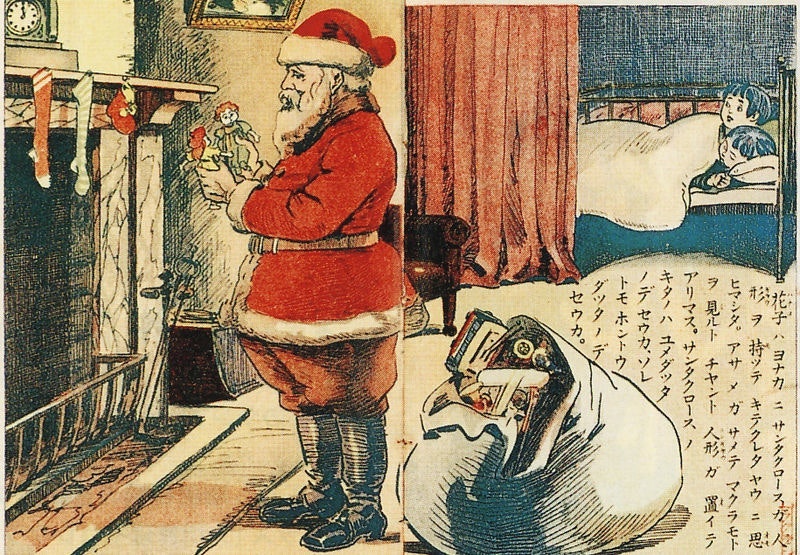
Japanese Santa Claus illustration, 1914
Nearly everyone has a favorite holiday tradition. Small children gravitate toward opening presents. Some people love shopping for presents, or wrapping them in a very creative way. For our daughter, it is decorating the tree. Our son still likes to leave out cookies for Santa, even though he is a teenager!

For several Jewish families on our street, it's lighting the menorah. For some Catholic neighbors, it's attending midnight Mass.

Music is popular, from religious songs to modern seasonal hits. Performances of The Nutcracker are frequently sold out in Boston. One of Nicole's colleagues has attended the Boston Pops annual holiday concert every year since 1987!

One of my favorite traditions is watching a film version of A Christmas Carol. There are more than a dozen movies dating back to the early 1900s, ranging from by-the-book renditions to musicals to modern adaptations. I prefer the 1951 black and white film starring Alastair Sim

This week, I read Dickens' original novella, A Christmas Carol. In Prose. Being a Ghost Story of Christmas. I expected it to be dated in language and plot, but that was not the case. Indeed, it was a gripping story that brings together horror, drama, and even a touch of humor - I couldn't stop reading! You can read it online here. Take a look at the vivid description of Ebenezer Scrooge on the opening page:

Oh! But he was a tight-fisted hand at the grindstone, Scrooge! A squeezing, wrenching, grasping, scraping, clutching, covetous, old sinner! Hard and sharp as flint, from which no steel had ever struck out generous fire; secret, and self-contained, and solitary as an oyster. The cold within him froze his old features, nipped his pointed nose, shrivelled his cheek, stiffened his gait; made his eyes red, his thin lips blue; and spoke out shrewdly in his grating voice. A frosty rime was on his head, and on his eyebrows, and his wiry chin. He carried his own low temperature always about with him; he iced his office in the dog-days; and didn’t thaw it one degree at Christmas.

Then we come to Scrooge and Marley, Ebenezer's place of business and the single-minded focus of his life - making as much money as possible, no matter the cost to the people around him:

The door of Scrooge’s counting-house was open that he might keep his eye upon his clerk, who in a dismal little cell beyond, a sort of tank, was copying letters. Scrooge had a very small fire, but the clerk’s fire was so very much smaller that it looked like one coal. But he couldn’t replenish it, for Scrooge kept the coal-box in his own room; and so surely as the clerk came in with the shovel, the master predicted that it would be necessary for them to part. Wherefore the clerk put on his white comforter, and tried to warm himself at the candle; in which effort, not being a man of a strong imagination, he failed.

No wonder "Scrooge" is now a noun for miserly tightwad! I won't spoil the ending, but A Christmas Carol is a story of redemption and finding humanity even in the most unlikely of characters.

Dickens' story was a hit the moment it was released in England in December 1843, nearly 180 years ago. It would have been a story treasured by generations of our English-speaking forebears, first in book form, then on the stage, and later in film.

Whatever holiday tradition you observe, enjoy the time to celebrate traditions and connect with family and friends.

Sunday, June 19, 2022

Father's Day memories: How farmers made Apple Jack


Thought I would share this story in honor of Father's Day. Last year, we had an outdoor brunch with my dad, who shared an interesting story about his own father, my grandfather. 

My grandfather came of age during Prohibition in farming country in western New York. The people there were not only skilled at procuring alcohol from north of the border in nearby Canada, they were also skilled at making it. Lots of people brewed beer or cider for underground sale or home consumption ... and sometimes made harder stuff, too. 

Apple Jack memories
"Apple Jack" was one type of home brew popular among the Irish and Scots immigrants and their descendants living in the area. My grandfather's method, according to my father, involved taking a casket of hard cider, and putting it out in the barn on a really cold night. The water would freeze around the outer edge of the casket, but the liquid in the center - concentrated cider with a much higher alcohol content - could be tapped and extracted. This was how Apple Jack was made in those parts, and in other parts of the northeast during colonial times.

My father also remembered going fishing with his dad in the 1950s, and stopping to buy worms from local apple farmers. It turns out that a certain type of worm used to thrive in the discarded mash from the cider presses. Fish apparently loved them, so farmers would sell them as bait. Part of the ritual when buying worms, my dad recalled, involved the farmer offering some sweet cider to the kids, and a glass of hard cider to the adults, if they were so inclined. On a hot summer's day, that must have been refreshing.  

The tradition of home-brewed alcohol still lives on. We used to live next to an Italian immigrant from Naples who brewed his own wine in the cellar and generously shared it with neighbors. It's very interesting to see much younger people who were born in the United States and have no family traditions getting into brewing beer using home kits. Others have gotten into craft beer, or spirits made by local companies, often family-owned companies.

Saturday, January 08, 2022

Pandemic-era Eagle Scout Service Project with the Boston Area Gleaners

Last summer, my son led his scout troop (Troop 355) to gather hundreds of banana boxes for a local group that fights food insecurity. This was part of an Eagle Scout Service project, which is required of all scouts seeking to attain the rank of Eagle. The following pieces of information are from the project summary he prepared.

The Boston Area Gleaners is truly a fascinating organization that not only provides fresh produce to local food banks, it also targets food waste on local farms by taking excess produce. The humble banana box is an important part of the storage and transportation infrastructure, as this video shows:


According to the Greater Boston Food Bank, the pandemic has caused food insecurity among children to rise 117% in Eastern Massachusetts so that now 1 in 5 children live in a home that is food insecure. In 2020, the Gleaners collected and distributed 8 million lbs of fresh produce to go on tables across New England. To run their operations, the Boston Area Gleaners need lots of banana boxes! 

The original goal of the project: obtain 400 empty boxes, and deliver them to the Gleaners by July 31st. This represents capacity for the Gleaners to transport 14,000 pounds of produce, enough fruits and vegetables for nearly 38,000 meals! Most cars can fit between 5 and 15 banana boxes each (bigger cars or trucks could most likely fit between 20-25 boxes).

By the end of July, scouts from Troop 355 as well as parents and siblings gathered 450+ banana boxes, and did so safely, following safe social distancing requirements. Twenty scouts from Newton and Boston took part, with support from scout parents, scoutmasters, and other members of the community.

Managers and staff at Star Market, Shaw's, Stop & Shop, Russo’s, Market Basket, and Whole Foods played a crucial role in setting the boxes aside, which otherwise would have been crushed or used for other purposes. 

It really was a great learning and leadership experience, and a great cause. Thank you all for your help!


Tuesday, November 22, 2016

Generation guitar fades away

Bloomberg has a story about Fender guitars that contained an interesting statistic: 90% of people who pick up a guitar abandon it within a year. The article suggests that people don't have the stamina to stick with it, even pointing out that "Steel strings hurt delicate hands."

I think there's something else going on. I heard an interesting theory from a friend in the music business, who said that high-quality PC and console videogames caused a seismic shift beginning in the 1990s, as teens gravitated to an immersive, often collaborative indoor activity.

If gaming (or apps, social media, whatever) are drawing away a large population of teens, not only are fewer people picking up a guitar or drumsticks but the number of available local bandmates declines, further weakening the allure of playing music. It makes a big difference if you have friends who also play. If your peers aren't doing it, music is more likely to be a solo activity which is not as much fun.

Another factor: from the 1950s to the early 2000s pop music heroes more often than not could also play guitar. I grew up in the 80s, and learned to play bass starting at age 16 by intently listening to cassettes of The Beatles, Who, Led Zep, U2, REM and the Sex Pistols so I could play with my friends and explore a new dimension of the music I loved.

I was never a hotshot player, but was competent at both the bass and rhythm guitar and played in lots of cover and original bands through my late teens and 20s in Boston and Taipei including The Fit (1986-87), The Dudes (1988-1990), Uckfay (1989-1990), Mr. O (1989-1990), The Librarianz (1993-1994), The Von Stainz and Swampus (1994-1996), Vine (1995), The M-9s (1995-1996), Feiwu/廢物樂隊 (1997-1999), Three-Ten (2000), and (briefly) Ambush at Junction Rock (2000). Some of my best friends today are people I played with decades ago, and one band, Feiwu, had two reunion shows in 2013.

My tween & teen kids have almost no interest in guitar-based pop music, although my daughter's middle school music curriculum included a segment on "90s music" which later prompted her to ask me, "Dad, did you know there was a song about a sweater unraveling?" (man, that made me feel old). They do listen to modern-day pop music, though, and sometimes to pop from previous decades that is not guitar-centric (Michael Jackson, etc.)

On the other hand, the apps and other tools that are now available to everyone--not to mention the ability to connect with like-minded people--can spark different types of musical creativity, collaboration, and insights. I did a double take a few months ago while listening to a radio interview with Philip Glass and my son casually remarked that one of his pieces from the late 1960s "sounds like 'My Singing Monsters'." I hope my kids do get interested in creating music and find an opportunity to collaborate, but I accept that it may not involve rock music.

Thursday, December 31, 2015

Hacking Chinese

I was recently asked an unusual question: What was my biggest non-technical hack? How had I found a workaround or trick that let me do something that ordinarily wouldn't be possible or allowed.

That made me think. The best example I can think of involves the study of Chinese. I was able to study the language in a way that reaped major benefits for my career and overseas lifestyle in just six months.

Backstory: I arrived in Taiwan in early 1993 to study Mandarin and continue an overseas adventure that had started in London two years prior. While Chinese grammar and syntax is quite simple, Western students are often tripped up by two extremely difficult elements: Tones in the spoken language and characters in the written language. Most curricula emphasize the latter through rote memorization (necessary for reading) and stroke order (necessary for writing). Writing/memorization exercises take up 75% of a student’s time.

Speaking was given short shrift in many programs at the time -- it’s difficult to effectively teach tones and vocabulary is always taught in conjunction with reading/writing. This really slows progress, as a single term takes extra long to learn, thanks to the emphasis on learning the characters as well as the spoken form.

The result is many people who have formally studied Chinese for a year or more are unable to effectively talk in Mandarin, but will be able to understand characters and even write calligraphy. I had actually taken this approach in the United States in high school and college for two years total, but only knew the words for numbers and a few simple phrases when I arrived in Taipei.

My "hack" was to skip writing and concentrate on the spoken language, with a minimal amount of attention devoted to learning characters. In other words, instead of spending 25% of my time on verbal exercises and practice, I spent 90% of my time on learning how to speak Mandarin.

 My first experiment involved self-immersion, living with a family on the outskirts of Taipei, where I thought I could have a chance to practice talking. It didn’t work -- the children in the family wanted mainly to speak English, and the parents spoke a different dialect that is mutually unintelligible with Mandarin. The experiment failed. I learned almost nothing.

I then decided to take formal classes. Most Western students studied at local universities, but I found a private language school that didn’t force character study at the early levels, and had teachers that really emphasized spoken Mandarin (to the point that no English was spoken in class).

Ten hours of study in school and hours of additional practice every day on the streets of Taipei really worked. I was intensely focused on getting the tones and pronunciation right. Within two months I had the local accent and tones down cold, to the point where some people hearing me answer the phone initially supposed I was local. Within six months I had learned enough vocabulary and grammar to become a highly proficient speaker. I could barely read and my stroke order was positively embarrassing, but it didn’t matter -- I was interacting with local people at a very high level on a face-to-face level and really becoming immersed in social life there.

 The proof of my competency came in mid-1994, less than a year after I had restarted my studies, when I was invited to take part in a highly competitive job interview for a news editor at one of Taiwan’s largest television networks. The interview was completely in Mandarin with three station executives. I passed with flying colors, beating out 300 other applicants. A few years later, I wrote and composed a Mandarin song for my rock band that became a minor underground hit in Taiwan and Hong Kong. It wasn't fine calligraphy, but it made it possible for me to interact with people and improve my own career.

Sunday, June 14, 2015

Lamont genealogy and the lost hamlets of Glengairn, Aberdeenshire

For years I have been researching the origins of my family. One of the most perplexing mysteries concerned the origins of my forebear James Lamont who emigrated from Scotland to the United States in the mid-1800s. I knew his name, his year of birth, the names of his parents and children, but little about where he came from. In the past few months, with the aid of a professional genealogist and a local historian in Scotland, I have narrowed the search to a remote area of Aberdeenshire, a historical district in Scotland. [Update: I have published additional posts relating to Aberdeeshire here: Ardoch Scotland revisited (2016) and Ardoch, Scotland in 1830: Recreated map and census (2019)]

Any American who attempts genealogical research of Scottish forebears is likely to run into a records gap when going back before 1850. The quantity and quality of census records, church records, newspapers, and other written documentation is poor -- for instance, the UK did not begin a census until 1841 and Scottish civil records (marriages, births, etc.) weren't really formalized until 1855. In the U.S., record-keeping tended to be somewhat better but there are still many gaps.

For James Lamont, we have a copy of his newspaper obituary in New York state, which was a trove of information, as well as his death record (kept on file in a small town in western New York) which listed his parents' names -- James Lamont and "Ann Mechie." Through the obituary and New York state and federal census records I was able to determine the year of birth (1814, most likely between January and May). While the obituary confirmed he was from Scotland, the only information about where in Scotland he came from was a reference in an 1870s "who's who" of Niagara County, New York, which listed "Knearden" as the family's place of origin in Scotland.

Here are some of the problems I encountered:
  • There is no town called "Knearden" in Scotland that I could locate.
  • Most Lamonts came from western Scotland -- Argyll. Family lore stated he came from Aberdeen, a small city in the east. But that did not make sense, considering James Lamont took up farm work when he came to America. He did not seem like a city fellow.
  • James Lamont was Catholic, an extremely tiny segment of the Scotland's population in the early 1800s (the entire Catholic population of Scotland was estimated at about 30,000 people in the mid-1700s, or about 2% of the population)
  • "Mechie" was probably misspelled, and perhaps a variant of Mackie, Mackaye or McKie.

After spending years trying to crack the "brick wall" I contacted the New England Historical Genealogical Society and commissioned their experienced genealogists to see if they could go further. Here's what they found:
We began our research by looking for the birth of James Lamont in Scotland. We were not able to find his record and decided to broaden our scope. Next, we looked for Scottish birth records for children of James and Ann (Mechie) Lamont. We were able to find one birth record for a couple of this name. Donald Lamond, son of James and Anne (Michie) Lamond of Ardoch, was born and baptized on 13 March 1814. Donald was baptized in St. Nathalan Roman Catholic Church in Ballater. The village of Ballater is in the parish of Glenmuick, Tullich and Glengairn in the Kincardine O'Neil district in Aberdeenshire [Aberdeen County], Scotland. Ardoch is located about 2 miles north- west of Ballater. It is possible “Knearden” is referring to the Kincardine O'Neil district. ... Next we turned to passenger arrival records. If James Lamont arrived in New York City about 1850-1851 it was before Castle Garden or Ellis Island were in operation. However, no arrival records was found for James or Helen/Ellen (____) Lamont in currently available digitized sources. It is possible the couple travelled via Canada to Niagara County, New York. Unfortunately, records for this time period in Canada are sparse and nothing was found for the family.
Interesting. The "Knearden" misspelling was plausible -- I could see the editor of a rural "who's who" in New York making the mistake, especially if the source had a heavy accent or wasn't sure of the spelling himself. This could also take care of the issue of James Lamont being a farmer - he wasn't from Aberdeen city, but rather a very rural area of the highlands in Aberdeenshire, a county-like district reaching deep into the Scottish Highlands. Even more interesting was the James Lamond/Ann Michie couple. I had been searching on "Lamont" and ignoring variations, but "Lamond" is actually a common variation. "Michie" is a rare Scottish surname.

Nevertheless, there were still problems with the NEHGS findings. This couple only had one child, born the same year, but with a different name (Donald, not James). What was going on here?

I searched the records of Scotlands People for other children born to this couple. Nothing. This was odd, as most families at the time tended to have many children.

What about this place called Ardoch? It was listed on historical maps:
Now it is only ruins, as shown in this photo collection. It's one of about a dozen abandoned hamlets a few miles north of Ballater in the valley of the river Gairn, known as Glen Gairn or Glengairn. It's not far from Balmoral, the British royal retreat. Until the mid-1800s most of the people of Glengairn were Catholic, in a mostly Protestant Scotland. They were protected by the fact that Glengairn was so remote and several powerful landowners in the area were themselves Catholic. But changes in the economy of the area -- including the creation of "deer forests" for nobles, the expansion of sheep farming, and the sales of large tracts of land -- encouraged many to move elsewhere or emigrate. A large number of Glengairn inhabitants emigrated to Australia, as well as some to Canada. And, perhaps, some to the United States.

As for the origins of the Lamonts in Aberdeenshire, I found this account taken from a 1938 clan history (The Lamont Clan: 1235-1935):
The earliest appearance of a Lamont in the Braemar district was in 1483 when an Archibald was in trouble for cattle lifting. Tradition insists that the first of the clan in that airt was a daughter of a Laird of Lamont who was married about this time to a McGregor of Inverey. Following the old Celtic custom of leine-chneis she took her retainers with her, and so was founded a new branch of the clan still to the fore to this day.
Braemar is located to the west of Ballater, perhaps 10 miles distant -- certainly not out of the realm of possibility for Lamonts from Braemar to settle in the hills north of Ballater.

"Lamond" is apparently a medieval spelling, and the same 1938 account explains more history about the Braemar branch and their connection with the main body of the Lamonts in western Scotland:
(In 1682) the Braemar branch of the clan, realising that Archibald [Lamont] was now a power in the land, applied to him for recognition and protection. Their petition, which is still to the fore in the National Library, is striking evidence of the strength of the bond between chief and clansmen though living beyond the ken of one another. "Ther will be in this countrey of the bray of Marr," it commences, " about fourtie men of our name of MackLamond trewlie come from your honor's country long since and be reason of some accidents hes turned our right name as is knowne to be verie usuall in highland countreys. Wee all of our race knowes our owine genelogie our selfes. Wee live heir honestlie altho' not rich nor in great power be reison we want on above the rest as a cheiffe to owine us & keip us unwronged." The bearer of this appeal, which must have been personally presented at Ardlamont was to explain in detail a particular grievance: “…all these who descended of him were commonly called Gordones, altho' the right name is Lamond. Otheres of us be reason of our predecessor's blackness are called Mcgildui.”
I called a local historian, who confirmed that the Lamonts were "thick around Braemar," not so much around Ardoch or Ballater. There were not any census records of Ardoch or the other forgotten hamlets in the Glen Gairn area, north of Ballater.

One thing I have learned in years of doing research is always look at the original source -- sometimes clues lie in the records themselves which may not be apparent from database searches or second-hand information. So I went to Scotlands People and downloaded an image of the baptism of Donald Lamond, born to James and Ann Michie and recorded by St. Nathalan Catholic church in Ballater:
Transcription listed below
One thing that was immediately apparent was other Lamonts lived in the area closer to Ballater -- a Donald Lamond of Lary was listed as the sponsor (Godfather) while a birth from February 1814 listed another Lamont birth, Margaret, born to Alex Lamont Margaret Farquarson.

I was curious. What was on the other side of the notebook of the baptism list from St. Nathalan? I downloaded it from Scotland's People:
Transcription listed below
Not only were there even more Lamont/Lamond baptisms listed, one of them was a James Lamond, born the same month as the infant Donald. James' parents were Donald Lamond and Helen Farquarson. They resided in another hamlet, Shenval, located less than a mile from Ardoch.

Wow. Was the elder Donald Lamond of Shenval who sponsored infant Donald Lamond the same person as the father of James Lamond? Probably not, as on April 6 1814 another birth was recorded for Donald Lamond of Lary and his wife Elspet Lymon. But considering the closeness of the three hamlets (Ardoch, Shenval and Lary) and the common forenames (two James and three Donalds) suggests some family connection -- most likely brothers and cousins -- is possible, or even likely.

Here are some other hypotheses: Was it possible that infant Donald Lamond had a middle name James, or the infant James Lamond of Shenval was for some reason brought up by James Lamond and Ann Michie of Ardoch? In the 1841 Censuses for the Parish of Crathie and Braemar and the Parish of Glenmuick, Tullich & Glengairn there are no traces of Donald Lamont or Lamond, but there are many households in which infants or young children are living with adults with different surnames -- perhaps relatives, or paid guardians, or orphans. Here is one household in the Glenmuick, Tullich & Glengairn census from 1841:
Enumeration District 5: From the junction of the Gairn with the Dee up the North bank of the Dee until opposite Terquach; thence to the top of the hill above Terquach; then east along the top of the hills above Terquach Micras & Gaelic in a straight line until it reach the Gairn at a point west of Culsh.
Place: Kylacreech
Euphemia Christie 70
Jane [Christie] 50
Jane McHardy 25
Lewis Symon 1
These are hypotheses, not definite answers. Still, the origins of this family loosely match the data we have from James Lamont of Niagara County, NY. The birth year of 1814 matches, and there were no other James Lamonts or Lamonds born that year. James Lamond and Ann Michie were the only couple in Scotland having a similar name to the parents on the Niagara County death certificate -- I did extensive searches of the Scotland's People database to see if any other couples with similar names were recorded, and came up empty. And then there's the family lore, which has the family coming from Aberdeen and the Niagara County book of local notables which lists "Knearden" but is very likely to a misspelling of "Kincardine."

I feel there is a family connection, but more research is needed. The smoking gun could come in several ways:
  • Another paper record from Scotland, the U.S. or Canada which confirms something about James' origins.
  • A document from the U.S. that states James' exact birthday -- if I can match it with one of the dates in the St. Nathalan records for March 2014, I would have confirmation of the line.
  • A DNA match with someone descended from the Aberdeenshire Lamonts/Lamonds. I started this line of research but unfortunately not many Lamont descendents from anywhere are in the 23andme or GEDMatch databases. (Note: if you have Lamont/Lamond/Michie names from Aberdeenshire in your tree, and use genetic genealogy tools, please search for my 23andme profile OR check your GEDmatch kit number against M841892)
  • A piece of information from someone reading this blog.
On this last point, if you have something to share relating to James Lamont (James Lamond) or his family, or know more about the Lamonts of Braemar and Glenmuick, Tullich and Glengairn, please write me at ilamont.com@gmail.com.

Transcription of St. Nathalan, Ballater, baptism records from November 1813 to autumn 1814:

November 30, 1813
TO Andrew Thomson and Marge Gordon[Tamedour Grashie?] a daughter 27 [Cur] and baptized Anne. Sponsor John Youll and Ann Callanach  Fergach

Dec 2 1814
To Alex Durevard and Jannet Farquarson [Dyke-head Corgall] a [daughter] born 28 [Ult] and baptized Elisabeth [ipie] & Jane Farquarson [Cochbridge] Sponsor

Feb 20 1814
TO Alex Lamont and Mary Farquarson [Dalduna Corgark] a daughter born 18 [Curt] and baptized Margaret. Alex and Mary MDonald sponspors.

March 5, 1814
To James McGregor and Jannet Mitchie [Clashindrian PG or “Clashinruich” where Father Lachlan McIntosh had a chapel?] a son born 3rd and baptised James. Donald MKenzie here and Jannet MIntosh sposnors.

March 13 1814
To James Lamond and Anne Michie Ardoch a son born this day and baptized Donald. Sponsor Donald Lamond Lary and Mary Duresand Ardoch.

march 21, 1814
To John McIntosh and Jane Shaw [Tonghaoith] Braemar a son born 20 [Cur] and baptized Alexander. Alex and Shusanna Shaw Corgallie Braemar are sponsors.

March 26 1814
To James MHardy and Jannet Lamond Auchindryne Braemar a daughter born 23 Cur and baptized Marg. John and Jannet Lamont their sponsors.

+++++++++++

March 31 1814
To Donald Lamond and Helena Farqu [Ghenvae …] [probably SHENVAL] a son born 28 Cur and baptized James. Sponsor John and Margret Grant, Torran [a hamlet next to Shenval and less than a mile from ARDOCH]

+++++++++++

April 5 1814
To John Lamont and Mary Farquarson [Corga] a son born Cur and baptized Donald ipse Marg Durnward Sponsors

April 6 1814
TO Donald Lamond and Elspet Lymon Lary a daughter born & Cur baptized Elspet. James Donald and Marcelly Lamond Sponsors

June 17 1814
To Jane Fleming Aberarder and one calling himself McDonald whom she never saw before or after. A daughter born May 26 and baptized Agnes ipse and Agnes Fleming Tullochnacraig sponsors.

June 18 1814
To Robert McKay and Ann MHardy Cockbridge [Corgar] a son birn this day and baptized George. [William] MKay Glenlivat and Sophia Wallie Cockbridge, sponsors.

[Next page]

To Alex MDougall and Elisabeth Donald, Lary, a daughter born 24 and baptized Jane. Sponsored James Donald and Jane Donald Lary.

July 3, 1814
To Charles Anderson [Loinchork] and Dianna [xxx] from the south both unmarried a son birn March 31 a baptized Robert Stuart sponsors John Callanach and Anne MGregor [Remerafo]

July 20 1814
To James Callanach nd Mary [Symongleach] a son birn 19. Cur and baptized Alex. Sponsors John Fleming and Mary Ferguson [Auchintoul]

July 27 1814
To Callum Keir and Elisabeth MKenzie, Morven, a son born 24 Cur baptised John. Sponsors John Keir Mulloch and Jane MGregor, Morven

Aug X 1814
To Will Callanach and Jannet Coutts [Gleach] a daughter birn this day and baptized Anne. Sponsor Mary Furguson and Charles Coullyty.

August 28 1814
To William and Anne Michie [or Ritchie] Ardoch a daughter born 27 and baptized Mary. Sponsor Donald Coutts [Benebroch] and Mary Reid, Dalfad

Sept 1 1814
TO Donald McDonald and Elisabeth McGregor [Blarglas] a daughter born 28 and baptized Anne. Sponsor Ann xxx MGregor Morven.
Update: I have published additional posts relating to Aberdeeshire here: Ardoch Scotland revisited (2016) and Ardoch, Scotland in 1830: Recreated map and census (2019)


Thursday, February 06, 2014

February 2014 Update

I haven’t posted to this blog for five months. This post is an update for old readers, and an introduction to new readers of what’s going on in my professional life.

For those of you coming to this blog for the first time, I am the founder of i30 Media, which publishes In 30 Minutes® guides. We publish information that helps people understand the complexities of the world around them.

Starting with a Dropbox user guide in the summer of 2012, we now have 10 guides available for the Kindle, iPad, Nook, and Android tablets. Besides the technology guides, there are also titles that help people understand health (C. Diff In 30 Minutes) and even a title about cooking (Easy Chinese Recipes In 30 Minutes).

Some people may think it’s crazy to start a new publishing or media company, but there is incredible opportunity in an industry that’s being disrupted.

My 20+ Year Perspective On Media

I’ve worked in media for most of my life. It includes stints in the music industry, broadcasting, newspapers, IT trade publications, and for more than 10 years, online and mobile media. I was also an MIT Sloan Fellow from 2010–2011, which really gave me a chance to learn about new media innovation, entrepreneurship, and business among some incredible faculty and peers.

In the past 20-odd years, I’ve learned that in the media business, no matter what you are producing, you have to stay on top of the platforms. If you stay focused on the past, or place your bets on a losing platform, you’re going to be in for a world of hurt.

You also have to focus on your customers, whether it’s readers, gamers, audiences, or whatever. That may seem obvious, but I still see many media products that are devised in a conference room, built over a period of a year or more, and then launched without any real idea if there are audiences out there who want to consume them. The crop of slick iPad apps pumped out by magazine publishers in the early part of this decade are examples. They were expensive gambles, and most failed.

Lean Media And In 30 Minutes Guides


My philosophy toward product development in the media world is something I call “lean media”, which draws upon the lean startup methodology as well as the MIT spirit of product development, which zeroes in on prototyping, metrics, and iteration. The lean media idea is to get products, marketing, and business models out in the marketplace as soon as possible. Make a true connection with your audience/customers. Measure the impact, iterate, and improve.

The term “lean media” may be new, but over the past half-century decades many successful musicians, game studios, blog sites, magazines, and app developers have used these ideas to get established. As a guy who grew up with classic rock, one example I like to point to is Led Zeppelin. Most people think of them as the bloated supergroup from the 1970s, but the way they established themselves starting in 1968 was totally lean — touring in small and medium sized venues, and recording on a shoestring. Their first album was recorded in 3 weeks, and their second, Led Zeppelin II, consisted of songs they wrote in hotel rooms and recorded in studios along their tour route. They had an instant feedback loop with their audiences, and man, is that stuff good! I see the same lean media spirit in some of the blog/news/new media companies that emerged in the mid–2000s, including Mashable, Gawker, and TMZ.

More recently, book publishing has seen the same sort of lean media innovation, enabled by powerful new platforms and business models. The Internet is only part of it. Amazon has been the provider of not only a platform for sales of ebooks and the devices to read them on, but also provides a platform for self-publishing — the KDP program.

For In 30 Minutes guides, I’ve leveraged these platforms and applied lean media concepts to new products, design, pricing, marketing, and more. Lean media methods help clarify what’s working, what’s not, and ultimately, what readers are willing to pay for.

While I will continue to post entries here, they will be infrequent ... I am simply too busy. The best way to keep up with what I am doing is to check out the In 30 Minutes blog and follow me on Twitter at @ilamont.

Onward and upward!

Saturday, August 31, 2013

Camping on Lovell's Island, Boston Harbor

It's strange to think there is this almost-abandoned place not ten miles from one of the great cities of the world. It's rural, and surrounded by ocean. One beach has the best skipping stones we've ever held. Weird things wash up here, including water-worn clay pipes and bricks. There are old ruins of houses and chimneys and rusted metal. Gigantic military fortifications from 100 years ago dominate parts of the landscape, with watchtowers guarding the eastern approaches and walled-off tunnels leading to secret bunkers. There are views of the city skyline, Boston Light, and incoming 787s. On summer weekends, it's surrounded by boats. Weekdays, only the ferries and freighters and screaming jets. There were few animals, just snails and crickets and at low tide, barnacles. Blackberries run riot.

Camping on Lovell's Island, Boston Harbor:


Friday, August 24, 2012

A core truth about writers

"Writing has always been a shitty way to make a buck, which has never really been a problem because mostly it’s done by people who can’t not do it."

- Tim Bray, Blogodammerung?

Monday, July 23, 2012

Feiwu returns/廢物樂隊回去台灣

feiwu band publicity photo


Feiwu
When I lived in Taiwan in the 1990s, I was in a hard rock band called Feiwu. The Chinese name was 廢物樂隊, meaning "good for nothings" or, as Google Translate says, "waste orchestra".

The band had five members in all from 1997 to 2001. Three of us were from the Boston area (Andrew, Bob and I), two of us from Taiwan (Steve and JoJoe).

Feiwu's first CD
The songs we wrote were original. Some were English, some were Mandarin. We recorded two CDs, and were signed to a local music label. We played all over the island, at clubs, festivals, universities, on the streets and under highway overpasses. One of the songs, "我愛台灣啤酒" ("I love Taiwan Beer") was a minor underground hit, and is still covered by local bands today.

One of the best things about Feiwu, besides writing and performing music with a group of close friends, was becoming a part of the local indie music scene. It was small when we started, but very dedicated. There were about three or four dozen bands around the island writing and recording their own music, a few practice spaces and recording studios in the main cities, clubs where we could perform, and the Spring Scream music festival (春天吶喊) which we played in 1998, 1999 and 2000 (see the inset picture below). There was a very strong DIY spirit throughout the small scene, and a feeling that people who loved music could make special music on their own terms.

Andrew and the Spring Scream crowd, 2000:

feiwu taiwan spring scream 2000

Importantly, there were a core of enthusiastic scenesters and casual fans who loved to see original bands perform. Once in 1998 I saw an outdoor show on the grounds of an abandoned brewery in the center of Taipei. It was pouring rain, yet there were hundreds of people right up front with huge smiles on their faces, soaking in the experience.

I left Taiwan in 1999, but Feiwu continued on until 2001. We had a brief reunion in 2003 when Steve came to Boston to study English, but we haven't played since then.

But ten years is a long time. Too long, for us. For the past few months, the band and some long-time supporters have been working on a reunion show in Taipei in 2013. It's not a done deal, but we really want to make it happen.

Stay tuned.

Update: If you're interested in learning more about the band, check out our Facebook page or the interview we did with GigGuide. We also have two Feiwu albums for sale on Amazon.


The local indie music scene, which was just emerging in the late 1990s, is now very strong (with thousands of bands, according to our old friend Freddy from Chthonic, interviewed in part 1 of the Garageland video series). Here's part 3 from the same series, featuring some more old-school scenesters, including LTK:

Sunday, June 17, 2012

Easy Chinese cooking: "Three Cups Chicken"/三杯雞


Three Cups Chicken recipe - preparing the ingredients
Three Cups Chicken recipe
This is a very good home-style Chinese recipe called "three cups chicken" (video and recipe below) which is part of Easy Chinese Recipes In 30 Minutes. As explained in the video we made at home, it's supposed to have a cup of soy sauce, a cup of rice wine, and a cup of sesame oil, but this is a variation -- we're using a lot less of all three ingredients and we skipped one ingredient, basil. For these reasons, in Chinese we are calling it “差不多”的三杯雞 or "懶人"的三杯雞, which means "just about" or "lazy man's" three cups chicken. But it still tastes great.

Another advantage of this Three Cups Chicken recipe: The main, must-have ingredients (chicken, garlic, ginger, soy, etc.) can be found in any American supermarket. For the special Asian ingredients such as rice wine (米酒), we give alternatives (in this case, water, beer or dry white wine).

It tastes great over rice, and we also recommend serving another vegetable dish with it (stir fried cabbage or mixed vegetables, etc.)

Three Cups Chicken recipe


“差不多”的三杯雞 or "懶人"的三杯雞
"Almost" three cups chicken or "lazy man's" three cups chicken

  • Six or seven garlic cloves, smashed
  • 2 inch long piece of ginger, skin cut off and sliced into 1/8" thick slices
  • (Optional) Three scallions, cut down the center and chopped into thirds
  • 2 tablespoons cooking oil (we used vegetable oil)
  • 10 pieces dark meat chicken - we used boneless thighs
  • 1/2 cup soy sauce
  • 1/4 cup rice wine, white wine, water or beer
  • 1 tablespoon sesame oil (you can probably live without this, but it adds a nice flavor)
  • some rock sugar -- start with 6 small cubes, then adjust to taste. Or use a teaspoon of white or brown sugar.
  • Handful of Thai or Italian basil, thick stems removed. (You should have this to make authentic three cups chicken, but you can get away without it, hence the name in Chinese, "lazy man's three cups chicken")

Put a large pot on the gas range, turn up heat to high. Throw in the ginger and scallion and garlic in that order. Make sure the garlic doesn't burn. Throw in the chicken in batches so at least one side gets browned. Stir it around so everything is slightly cooked on the outside (browning is ideal, but not required), maybe 10 minutes or so. Add the liquids. It should start boiling quickly. Note the chicken should throw off some liquid, too. Turn down heat to low-medium, cover and cook for 10 minutes.

Open lid, add the sugar, check the liquid. You're going to end up with a thick sauce that coats the chicken but doesn't really pool at the bottom, so if it's thin and an inch deep it's time to turn up the heat and leave the lid off. Pay close attention and stir regularly so it doesn't burn. Do this until the sauce is thick, around 20-30 minutes. Turn off the heat. Add the basil, stir it around. Serve on white or brown rice.

Three Cups Chicken recipe video