Showing posts with label Software. Show all posts

Sunday, August 28, 2011

Visualizing professional LinkedIn networks

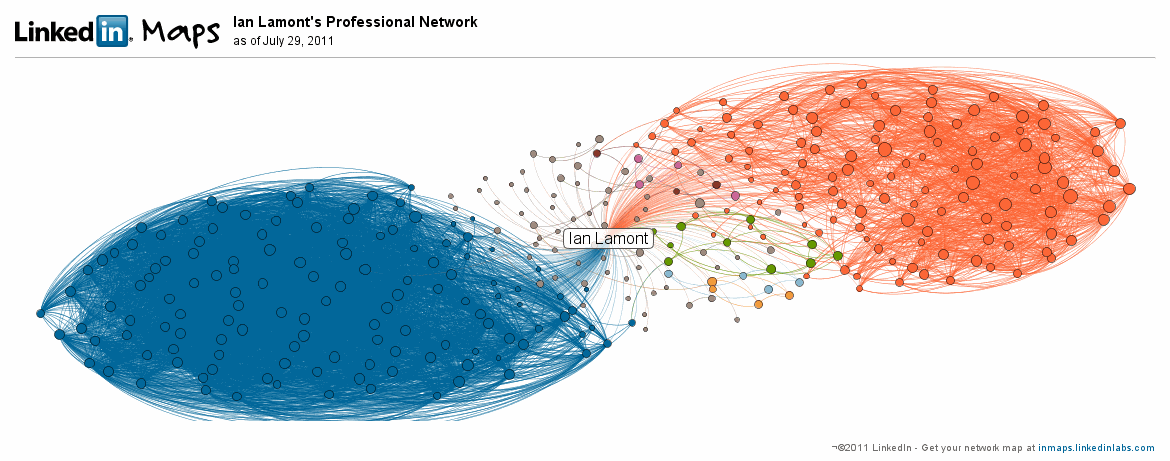
This is cool. LinkedIn has developed a visualization for members' professional LinkedIn networks. I spotted an example on a blog that I was browsing, and was curious to see what turned up for me. I was kind of surprised by the results:

linkedin data visualization

What's going on here? In a nutshell, my map reflects two major networks I am a part of: My MIT Sloan Fellows class (blue) and IDG Enterprise (orange).

The Sloan Fellows group of about 100 people are so connected with each other (i.e., nearly everyone is connected with everyone else in the group) that the lines between them form a nearly solid mass of blue. A few people on the outside of the blue mass are MIT students from other programs (e.g., the two-year Sloan MBA) who have a few connections with others in my class.

The orange network consists of former colleagues at IDG Enterprise -- mostly editors and technical staff but also some business executives. There are also many lines between them, but not nearly to the same degree as the Sloan Fellow network. That's because the IDGers are more likely to be connected to people in their own publications (Network World, Computerworld, The Industry Standard, etc.) and/or to people having similar roles (editors with editors, developers with developers, etc.). As I worked at three IDG publications and in many cross-functional teams from 1999 to 2010, I am pretty well connected across these groups.

Smaller LinkedIn groups: Who are they?

There are some interesting small groups near the center of my galaxy. They aren't necessarily close to me; rather, it appears smaller networks (light orange, green, and magenta) or single connections (gray lines) are shown nearer to the center of the visualization. The colored networks include a group of a half-dozen people (green) I met at the State of Play conference in 2007 and connected with on LinkedIn immediately afterwards. I haven't had much contact with any of them since then.

Another group (magenta) consists of high school pals who I have had regular contact with over the years, but are barely noticeable on the map, owing to the fact there are only four of them. Actually, there should be five magenta dots, but one of the guys who is connected with me is not connected with any of the others, and therefore shows up as a single grey dot -- even though he happens to be one of my closest friends.

LinkedIn Taiwan

Not reflected at all is my extensive network in Taiwan, which I developed over a six-year period in the 1990s when I lived in Taipei. If it were visualized, it would have about 20-30 people with slightly less density than my IDG network.

Why isn't it there? Two reasons that come to mind are the network predates LinkedIn by many years, and many of the people who I know from that period of life are Taiwanese and are therefore less likely to be LinkedIn users (social network usage in Taiwan evolved much differently than it did in the U.S. and other countries). While I have still connected with about a half-dozen people from my time in Taiwan, they show up as gray dots because I knew them from different settings (social, music, different jobs, etc.) and they are not connected with each other. It's also possible they haven't learned how to leverage LinkedIn, although there are many LinkedIn books available for people who want to understand how to create a profile and build their networks.

Nevertheless, it's an interesting visualization and makes me wonder if I need to develop other professional networks in new ways. You can try it out by visiting InMaps (Update: It's no longer active), which will require you to authenticate through your LinkedIn account.

Sunday, August 14, 2011

How to become a good writer

I have a one-word piece of advice for anyone who wants to learn how to write:

Blog.

Don't worry about which software to use, how to customize your template, or how to promote your thoughts. Just find a service that lets you start writing right away, and then start writing about what interests you or inspires you.

If you feel intimidated by formatting or structure, a trick that works well is pretend you are writing an email to a friend, explaining to that friend something that he or she may not understand very well. Real friends or strangers may start to read your posts. How do they respond to your presentation of facts, observations, and arguments? Use the feedback to tweak your approach.

Your organization and "voice" may seem awkward at first, but regular practice -- every day, if you can manage -- will help you develop your skills. After 100 hours you'll notice a big improvement. After 1000 hours, you will be well on your way to being a master.

Monday, July 04, 2011

Buttons won't solve the fundamental flaws of Wikipedia's editing policy

Wikipedia is rolling out a new tool called "WikiLove Buttons." The experiment, as explained by Howie Fung, Erik Moeller, and other top editors, is a weak response to a rather significant problem: Ordinary people ("new editors") don't like being shut out of articles, and when their edits are removed (or even savagely put down by experienced editors) they are less likely to want to contribute again. This undermines the crowdsourcing mission upon which Wikipedia was founded, and erodes quality. Unfortunately for Wikimedia, Inc. and its hundreds of millions of users, this roundabout way of showing appreciation for newbie edits by using a love button won't solve the problem of condescending uber-editors putting down perfectly good edits based on misguided policies, poor/incomplete understanding of topic issues, or inflated ego.


Ordinarily I wouldn't bother writing about this, but what prompted me to was the ReadWriteWeb review of the love button by Marshall Kirkpatrick. I generally like Kirkpatrick's writing but I really dislike when Wikipedia is unquestionably held up as a reliable source of information -- especially by people who speak with authority. While it can be considered a starting place for basic facts, it's hardly a reliable or complete source of information, as I described in my comment left at the bottom of the RWW article:

Disagree with the statement that Wikipedia is an "undeniably good source of information on almost any topic." For some topics, yes. But many others are flawed.

For instance, articles about famous living people are often sanitized by their handlers or supporters. Non-Western topics on English-language Wikipedia are shallow and/or unable to cite primary and secondary sources in other languages. Wikipedia editors do not view blogs as reliable sources, even if the authors are experts in said topic. And attempting to correct mistakes or add information to certain articles often brings up an array of badges, warnings, and restrictions that make it practically impossible for "the crowd" to edit.

As for the new feature, the love icons seem to be designed in a way that they make browsing and contributing more difficult. This may make things better for "top nerds at Wikipedia" but I doubt it will lead to a better product or experience for the rest of us.

Monday, June 27, 2011

WorldTV - our MIT Media Lab final project

One of the more interesting class projects I took part in during my last semester at MIT was our MIT Media Lab final project for MAS 571 ("Social TV: Creating New Connected Media Experiences"). The project was called WorldTV, and with my team (Jungmoo Park, MBA '11, and Giacomo Summa, MSMS '11), we created a pretty slick video demonstration of the proposed software UI. The video was shown at the MAS 571 demo day at the Media Lab (you can watch it below) and we wrote an accompanying concept paper that we are in the process of preparing for an IEEE CCNC workshop. In the following post, I'll describe not only what WorldTV is, but its genus and some of the reaction we've received so far.
world tv
WorldTV is a television app and accompanying mobile app for browsing user-generated video from one's social circle, as well as event video produced by strangers that tie into one's news and cultural interests. Instead of using traditional browsing methods -- scrolling through channels or searching for videos -- the proposed service uses a 3D globe as a navigational tool. WorldTV is aimed at people with global networks, which might include people with friends, relatives, and colleagues from other countries; people who spend a fair amount of time travelling; or people who are interested in news or culture in other countries.

The concept had great appeal to the entire team, not only because of our backgrounds (Giacomo is from Italy, Jungmoo is from Korea, and I spent most of the 1990s living overseas) but also because all of us have observed the exponential growth of user-generated video and realize its power and appeal to ordinary people. In 2006, I wrote about the potential of geotagged, time-stamped online photos to give insights into local events. I expanded the idea to include tweets and user-generated video in a proposal for my Linked Data Ventures class called PPP (PixPeoplePlaces). When I began the Social TV class, I took the PPP concept even further with user-generated video, emphasizing the social aspect of plotting event video on a local map (this was the basis of my first assignment for Social TV -- you can see the poster here).

Developing WorldTV - our MIT Media Lab final project

I envisioned all of these ideas as Web apps displayed on a computer monitor. For one of the early poster sessions for the Social TV class, Giacomo independently came up with a different approach. He asked, why not use a full-sized television screen to display a map of the entire earth with hot spots that reflected breaking hard news events that might be captured by amateur shooters? (This happened as anti-authoritarian demonstrations were breaking out across the Middle East in early 2011). Instead of being a "Lean Forward" experience (something that requires user input or interaction, such as a video game) this would be a "Lean Back" experience, in which the viewer could sit on the couch and take in the video. Giacomo also considered how video could be differentiated on the global map with different sized or colored markers, and how "likes", social networks, or newspaper articles could determine what appeared on the screen. He called it "WorldTV".

There was clearly some overlap between our ideas, and we decided to team up for the final project. We expanded the concept to include not only video from breaking news in other countries, but also cultural events (festivals, parades) and entertainment (sports, performances, etc.). The social filter would not only display streaming/recent videos from one's social circle, but could also reflect the collective interests of the social circle.

WorldTV business model

An additional requirement for the final project was a business model. I had already been thinking about using phone and laptop cameras as a way for ordinary people to access amateur expertise all over the globe, for a price. Examples of amateur expertise might be a power user demonstrating how to use a new gadget, advice on registering a company in a certain state by an experienced business owner, practicing foreign language conversation with a native speaker, etc. I dubbed the scheme Real Time Requests. (RTR). A live auction and reputation system would determine prices paid by people seeking expertise, and match them up with sellers. We decided to fold it into the proposal. The idea was then debuted at another MAS 571 poster session in April:


Jungmoo, who had a background as a professional television reporter for a Korean broadcaster, was intrigued by our poster session presentation and joined the team. Our next task was to take the concept and make a demo to show at demo day at the MIT Media Lab in the last week of class in May. For the final deliverable, we didn't have the skills to produce a working prototype. However, we did have the skills to produce a software mockup and accompanying video demo.

The team got to work. I created a simple WorldTV television UI using HTML and CSS, built the maps with Google Earth, and mocked up a mobile UX on an iPhone "remote". Giacomo wrote the script and starred in the video. Jungmoo took the raw video and graphics and used his professional editing skills to create a really slick video demo, which is shown below:


We presented the video and an accompanying slideshow on the business model last month at the Media Lab. Our Media Lab instructors, Marie-José Montpetit and Henry Holtzman, invited a group of industry pros from major cable and national broadcasters (including NBC and WGBH) to watch all six student presentations. After seeing our team present, one of the NBC visitors was interested in the idea of "shared experiences." Giacomo explained that user-generated video around sporting events and concerts could populate the global view, depending on how one's filters were set up. This prompted another executive, who I believed was from HBO, to question the legality of using amateur concert video. I responded that copyright law was decades behind the technological and social reality, but she was skeptical. I then said that there would always be artists who want to exercise strong control over this content, but there were also many artists who recognized the value of fan content to generate additional interest or loyalty, and in my opinion, the latter group would have a competitive advantage. But as I thought about it later, it was clear that addressing the entertainment industry's copyright concerns would be a huge issue, regardless of how outdated the laws are.

Our team also heard from Henry, who thought the Real Time Requests business model was really a separate concept that did not match WorldTV. We agreed. Jungmoo and Giacomo had actually raised the same concern in our planning discussions, but I felt we needed a business model that did not involve standard subscriptions. Henry noted that a subscription might actually work for some people.

So what's next for WorldTV? All members of the team have graduated, and none of the industry visitors seemed interested in taking it further. We hope, however, that if our paper is accepted to the IEEE CCNC '12 conference, it might get some traction. In the draft that we are now preparing, I outlined the "Future Work" required to make WorldTV a reality:
The next steps for WorldTV would be to create a working prototype using Google Earth, YouTube and Facebook APIs, the Android or iPhone SDKs, and other existing software and hardware components. Besides using the prototype to evaluate functionality and performance, ordinary users in the target audience (people having global networks) could also test the system with an eye toward determining which features and use cases hold the most promise. When the product is ready for wider distribution, identifying suitable “TV App” platforms and partnerships could take place. In the long run, creating a scalable architecture with its own API and opening up WorldTV to outside developers (much like Facebook and Twitter have done) would help unleash the greatest potential of the platform. This would require significant investments, but in the long run would help realize innovations for the next age of television.
If the paper is published, I will share a link on this space. In addition, if anyone is interested in learning more or helping to develop the idea, my contact information can be found here.

Sunday, March 27, 2011

A curriculum for learning computer programming in WoW

(Updated: See note at bottom of post) What can you learn from the MMORPG World of Warcraft? A lot, it turns out. This is one of my conclusions from taking CMS.863J -- Computer Games and Simulations for Investigation and Education, taught by Eric Klopfer and Jason Haas. It's one of the classes offered this semester by MIT's Comparative Media Studies department, and is also cross-listed under Course 11 (MIT's Urban Studies department). Aside from myself and one other graduate student, all of the other people taking the class undergraduates, many in Course 6.

As indicated by the name of the class, the curriculum centers around computer games and educational theory relating to games and learning. However, like every other media and entrepreneurship-focused class I have taken at MIT, there is also a heavy focus on creating and building (Mens Et Manus is the institute's motto). In February, after getting up to level 13 in World of Warcraft and conducting quests with classmates in-world, we split into teams with the mission of building a sample curriculum around a specific topic area, using WoW as the learning environment.

A curriculum for learning computer programming in WoW
You may find it strange that a game like WoW can be used to study real-world topics, but there is actually a fairly long history of players using the virtual worlds to study or understand various phenomena. Edward Castronova's oft-cited 2001 paper on virtual world economies opened up a floodgate of research and academic discussion relating to massively multiplayer online games. Specific to World of Warcraft, the game has been used to study epidemiology, as well as topics related to learning. In 2008, a paper by Constance Steinkuehler and Sean Duncan in the Journal of Science Education and Technology studied scientific reasoning in thousands of WoW forum posts. They found that 86% of the posts contained "social knowledge construction," or "the collective development of understanding, often through joint problems solving and argumentation."

As expected, many of these posts consisted of discussions around certain classes of characters, spells, weapons, etc. However, 10% of the total posts studied used model-based reasoning, including mathematical models to explain some phenomenon. An example cited in the paper showed one player who apparently reverse-engineered damage algorithms in WoW to compare the abilities of priests vs. mages:

By intuition, you should notice a problem... but I’ll give you the numbers anyways 

For Mindflay, SW:P, and presumpably VT [3 priest spells]: Damage = (base_spell_damage + modifier * damage_ gear) * darkness * weaving * shadowform * misery 

For Frostbolt [mage spell] Average Damage = (base_spell_damage + (modifier + empowered frost) * damage_gear) * (1 * (1 - critrate - winter's chill - empowered frost) + (1.5 + ice shards) * (critrate + winter’s chill + empowered frost)) * piercing ice mindflay = (426 + 0.45 * dam) * 1.1 * 1.15 * 1.15 * 1.05
650.7 + 0.687 * dam 
frostbolt = (530 + (0.814 + 0.10)*dam) * ((1 - crit - 0.10 - 0.05) + (1.5 + 0.5) * (crit + 0.10 + 0.05)) * 1.06 
(530 + 0.914 * dam) * ((0.85 - crit) + 2 * (crit + 0.15)) * 1.06
0.968 * (dam + 579.7) * (crit + 1.15) 
Please notice the 0.687 versus the 0.968. That's the scaling factor. 

After students in our class had gotten the hang of WoW, there were discussions around how the game could be used to study trigonometry and group psychology. Our team, consisting of Andrew Hsiao and Michele Pratusevich (both course sixers) and myself, opted to use WoW as a platform for high school students to learn basic computer programming concepts, using a simple scripting language called Lua that can be run from within the WoW chatbox. Here's the curriculum that we developed:

Teaching Computer Science Through WoW Scripts

Michele and Andrew were the true domain experts here, and designed all four of the CS class exercises and most of the assessment. I concentrated on the introduction, theory section, and managed to create one of the assessment scripts (the simple currency exchange/variables exercise).

WoW computer programming curriculum review

I personally believe the curriculum we designed is a very effective and engaging method for introducing basic computer science concepts to high school students. Once they've established a WoW player account and learned some of the basic game functionality, it's so easy to experiment with the code, and try new functions from the WoW API. Our instructor said the curricula that the student group developed will be passed to testers at NYU, but I don't know if we'll get any feedback on how our CS curriculum fared. If you are a teacher and try it, or are a solo learner who wants to study basic computer science concepts while playing WoW, please feel free to give it a spin and let me know how it works.

My next assignment for CMS.863J, with a different group: Creating a board game to teach fundamental electrical engineering concepts. You can see our test board here, and I'll try to post more information about the project as development progresses in April.

Update: An NYU class has reviewed our curriculum. Their comments can be seen on the post, "A curriculum for programming, reviewed"

Saturday, March 19, 2011

Solutions for the academic/mass media divide

"Why don't journalists link to primary sources?" The question was posed on Hacker News, and was based on a Guardian article lamenting sloppy reporting in the Daily Mail and Telegraph.

It prompted me to write the following response in the Hacker News thread:

If you asked most reporters whether they used primary sources, they would say yes, and point to the interviews that they conduct.

But if you were to point out that primary sources also includes published research, almost to a man or woman they would say A) they don't have the time to read it B) they don't have access to the journals or C) they are not aware the research exists. A few might concede D) even if they had access, they wouldn't be able to understand the research, which points to the fact that most journalists didn't major in science/technology in college and academic writing can be difficult to penetrate.

Of the above factors, I think C presents an opportunity for academics and startup publishers. On the academic side, it's pretty clear that the traditional method of reaching out to reporters via press releases and personal contacts is becoming less viable as newsrooms cut staff and the remaining writers have less time to network/talk with sources (travel budgets to attend conferences are very restricted these days) and write up stories based on those encounters.

Some researchers have seized upon blogging as a great way to not only reach their peers, but also a wider audience, and of course, other media (including journalists, specialist blogs, etc.). Group blogs written by researchers and experts are another great way to highlight new research and discuss ideas, too. Terra Nova ( http://terranova.blogs.com/ ) is one example focused on virtual worlds; I am sure the audience here knows of many others.

But the problem with individual and group blogs is they are still largely unknown outside of a relatively small group of people. In order to make a mass audience connection, there needs to be a way for these ideas to be presented in newspapers and television reports (which is how many people still learn about the world around them), or on media websites.

An arrangement to republish blog content or for the blog authors to prepare easy-to-understand summary reports for a mass media audience are possibilities, but the processes and incentives need to be worked out -- preferably in a way that takes the load off of editors, who don't have the time to find the right bloggers and deal with the freelance contracts and payment issues. One startup idea would be to create a "marketplace" to match publishers who are seeking an informed report about a specific scientific topic (for instance, how a boiled water reactor works). Another avenue for a startup would be to set up a "science wire service" which prepares timely, relevant coverage (including blogs, video, and features) about new research and developments every day. Media companies could subscribe to the service and editors could browse the service and use as much as they like, just as they do with Reuters, Bloomberg, AP, etc.

As for the specific issue of not including links, this partly relates to the awareness and access issues mentioned above, but also to the fact that content management systems used at many newspapers and magazines are optimized for print publishing, not online publishing. Inserting links typically has to be done *after* the article has been written, often by different editors or producers who know how to use Wordpress/Drupal/homegrown tools. I think there's a startup opportunity here as well, but unfortunately it also requires a rethinking of newsroom processes and control.

The debate reminded me of my "Source Blocks" idea from 2008. It never caught on, for the simple reason that most writers (including me) are too lazy to manually include them. But that could be an opportunity for another new media product ...

Wednesday, March 16, 2011

The challenges of creating a mobile educational app based on Linked Data


Earlier this month, my iPod touch flashed a warning message that the provisioning profile on the test application our team (Sloan Fellow Mads, Course 6 undergraduate Yod, and myself) had designed for 6.898 in the fall was about to expire. Before it did, I decided to make a quick video showing the basic design and functionality of our educational app for the iPhone and other iOS devices:

Video: Knowton demonstrated:


While the app was ostensibly designed to teach young children geography facts, the purpose of building it was to show how Linked Data could be used to make an educational application on a mobile device. Mads' original concept was to have an open-ended exploratory app that would let children freely jump from one object to an associated fact. For instance, the child might be interested in a monkey, be able to see a picture and read some information about it, including the facts that it lives in a tree and likes to eat bananas. At that point, the child could either choose to learn about trees or fruit.

This idea is eminently suited to Linked Data, which is essentially a distributed, global-scale database  built around Semantic Web standards such as RDF, turtle/N3 and SPARQL, shared definitions, and links between repositories. There is an enourmous collection of Semantic Web-based data already available, ranging from Wikipedia information to creative commons-licensed photos.

I suggested narrowing the focus to geography, as presenting facts about animals and their habitats could be tied to a specific learning outcome. I also designed a rudimentary user interface and flow (see wireframe  below), which was eventually adopted for the exploration part of the app. Yod designed the basic game flow and built several code repositories, including the mobile app (using the iPhone SDK) and a Web app that let editors (us) submit information such as photos and descriptions. Mads devised a business plan.

In a perfect Semantic Web world, it wouldn't be necessary to have the Web app for editors, as SPARQL queries on consistently structured graphs could build the data store, with only a minimum of cleanup and selection (such as choosing the most suitable photos). But we quickly discovered that DBPedia, a popular source of country-level information for local fauna and landmarks, was incomplete. Freebase filled in many of the information gaps, but there were so many differences from country to country that the only practical way to tackle the task of preparing the data for the mobile app was by using the Web interface that Yod created. For geography and many animal photos, we used a source that one of the guest lecturers in class had mentioned, Ookaboo, which contained creative commons and public domain photos. Others were sourced from Flickrwrapper using a feature in Yod's Web application.

But for good "people" photos that could not be easily accessed in Flickrwrapper using basic search strings, I had to resort to finding creative commons-licensed (CC-SA) on Flickr itself and copy and paste URLs into the Web app. Even if we had been able to use Linked Data without the manual workarounds, there is no way we would have been able to run live queries from the mobile app -- not only are mobile network connections unreliable, but we discovered that many of the sites have high latency and/or frequent downtime (DBPedia especially!). As an alternative, Yod built a database that loaded onto the app and was instantly accessible by users.

On demo day on December 7, all of the 6.898 teams gathered in a CSAIL conference room at the Stata Center. Tim Berners-Lee and a group of outside judges watched our demos and listened to our business pitches. TBL's quick assessment of the projects is in the video at the bottom of this post, but we approached him afterwards to ask him about the curation problem. He suggested some AI alternatives. For instance, if Linked Data sources identified "China" as alternately being a country or a person, he said the app could choose the most suitable definition based on the number of returned sites in competing Google searches.

TBL asked about photos in Flickrwrapper. Could Flickr ratings be used to choose better-quality photos? Yod said no. TBL suggested that some geocoded logic could be used to get the best Big Ben photo. "Make sure it's 300 meters west at a certain time during the day," he said, and then joked: "But how can you be sure that it's not a photo with Aunt Jenny in the frame?" He speculated that an algorithm could help choose photos based on contrast or some other value.

Video: Tim Berners-Lee reviews the 6.898/Linked Data Ventures class projects (Knowton comments at 2:50)


Other posts about my MIT Sloan Fellows experience:

Tuesday, March 01, 2011

Social TV poster #1: PeoplePixPlaces

(Update: This concept has evolved further and turned into a final project called WorldTV, complete with a software demo and video) From the Social TV class I'm taking this semester at the MIT Media Lab: A social TV application based on news. I came up with PeoplePixPlaces, a Web-based application that gives a window into local news, using geocoded video, pictures, and tweets, as well as individual users’ own social lenses. The poster explains the concept in more detail:

social TV

The genus of the idea predates MAS 571. Last semester in 6.898 (Linked Data Ventures), I proposed a similar project, PixPplPlaces. The one-sheet vision:


“People want to know a lot about their own neighborhoods.”

- Rensselaer Polytechnic Institute Professor Jim Hendler, discussing Semantic Web-based services in Britain, 10/18/2010

While superficial mashups that plot data about crime, celebrity sightings, or restaurants on street maps have been around for years, there is no service that takes geotagged tweets, photos, and videos, as well as associated semantic context, and plots it on a map according to the time the information was created. The idea behind PixPplPlaces:

• Index some publicly available location-based social media data in a Semantic Web-compatible form
• Plot the data by time (12:25 pm on 10/24/2010) and location (Lat 42.33565, Long -71.13366) on existing Linked Data geo resources
• Bring in other existing Linked Data resources (DBPedia, rdfabout U.S. Census, etc.) that can help describe the area or other aspects of what's going on, based on the indexed social media data

Potential business models:

• Professional services: News organizations can embed PPP mashups of specific neighborhoods on their websites, add location-based businesses who are their ad clients, or use the tool as an information resource for journalists -- what was the scene at the site of a fire on Monday evening, just before the fire broke out? Lawyers, insurance companies, and others might be interested in using this for investigations.
• Advertising services: A suggestion from Reed - "a source of ads/offers in Linked Data format - for the sutainability argument as a business. Maybe in the project you can develop an open definition that would let multiple providers publish ads in the right format that you could scrape /aggregate and then present to end users? If you demonstrate a click-wrap CPC concept you might be able to mock it up by scraping ads from Google Maps or just fake it."

To be researched:
• Is social media geodata (geotagged Flickr photos, geolocated Tweets) precise enough to be plotted on a map?
• Should this be a platform or a service?
• How can the data be scraped, indexed, or made into "good" Semantic Web information?
• Would any professional organization -- news, legal, insurance -- pay for it?
• How viable is the advertising model in a crowded field chasing a (currently) small pool of clients?
The Semantic Web requirements for the 6.898 project and emphasis on tweets and photos gave the tool a different flavor than the Social TV version; in addition, I didn't consider the possibility of using "social lenses" to filter the contributions of people in the user's social circle. But for both projects, I recognized that the business case is weak, not only in terms of revenue, but also in terms of maintaining a competitive advantage if open platforms and standards are used.

Incidentally, I first had the idea for a geocode-based application for user-generated content back in 2005 or 2006. My essay Meeting The Second Wave explains the original idea:

In the second wave of new media evolution, content creators and other 'Net users will not be able to manually tag the billions of new images and video clips uploaded to the 'Net. New hardware and software technologies will need to automatically apply descriptive metadata and tags at the point of creation, or after the content is uploaded to the 'Net. For instance, GPS-enabled cameras th at embed spatial metadata in digital images and video will help users find address- and time-specific content, once the content is made available on the 'Net. A user may instruct his news-fetching application to display all public photographs on the 'Net taken between 12 am and 12:01 am on January 1, 2017, in a one-block radius of Times Square, to get an idea of what the 2017 New Year's celebrations were like in that area. Manufacturers have already designed and brought to market cameras with GPS capabilities, but few people own them, and there are no news applications on the 'Net that can process and leverage location metadata — yet.

Other types of descriptive tags may be applied after the content is uploaded to the 'Net, depending on the objects or scenes that appear in user-submitted video, photographs, or 3D simulations. Two Penn State researchers, Jia Li and James Wang, have developed software that performs limited auto-tagging of digital photographs through the Automatic Linguistic Indexing of Pictures project. In the years to come, autotagging technology will be developed to the point where powerful back-end processing resources will categorize massive amounts of user-generated content as it is uploaded to the 'Net. Programming logic might tag a video clip as "violence", "car," "Matt Damon," or all three. Using the New Years example above, a reader may instruct his news-fetching application to narrow down the collection of Times Square photographs and video to display only those autotagged items that include people wearing party hats.

For the Social Television class, we have to submit two more ideas in poster sessions. I may end up posting some of them to this blog ...

Saturday, February 19, 2011

Synthetic voices for the future

During lunch at the Media Lab last week, I told a friend that synthesized voices will never sound like the real thing. It was in the context of machinima, and an idea that I have been thinking about for the past five years (see the section "3D Modding, 3D Media, on my essay, "Meeting The Second Wave").

"Have you heard Roger Ebert's new voice?" he asked. I hadn't, but knew that the film critic/commentator was unable to speak, owing to the terrible effects of cancer. "Check it out, it's amazing," he said. "They used old clips from his TV shows to build a library for computerized speech."

Intrigued, I did. A demo featuring Roger and his wife, originally played on the Oprah Winfrey show, shows what it's like:


Note there are two synthesized voices he uses -- a synthetic male voice from a standard voice software program, and a new product developed by a Scottish company, CereProc. For decades, until the effects of cancer killed his voice, Roger co-hosted a popular television show that covered new film releases. Through the program, he developed a wonderfully smooth talking and debating voice (he frequently sparred and joked with his first co-host, the late Gene Siskel). CereProc was able to leverage this library of sound, so when Roger types a sentence on his laptop, the program "reads" out what he said, stitching together words from his old television programs.

Is the new speech technology from CereProc perfect? No. But it's much better than the synthetic male voice, and really shows where the technology is heading. I can see people in the future "training" a synthesizer using their own voice (or old audio/video clips) for all sorts of functions. It will be a godsend for people who have lost their ability to speak, but can also be applied to services ranging from voice mail/IVR, news programs based on the "voices" of famous (or obscure) people, and machinima.

More blogging about virtual worlds:

Friday, February 18, 2011

My MIT center of gravity shifts to digital media ...

An update on my Sloan Fellows experience: Last summer and fall, the Sloan Fellows curriculum was dominated by the core. For the two electives in the fall, I pushed for Internet/digital media offerings (6.898/Linked Data Ventures and my G-Lab project, which involved helping a Vietnamese Internet company develop their infrastructure and mobile strategies). Now, with the elective firehose on full, I am taking as many digital media-related classes as I can, with an emphasis on team-based coursework that involves product development and real business plans.

I am taking two classes at the Media Lab (MAS.664/Media Ventures, MAS.571/Social Television), one class (CMS.863J/Computer Games and Simulations for Investigation and Education) cross-listed under Comparative Media Studies/Course 9/Course 11, plus two Sloan classes that directly involve software and online media (Business of Software and Digital Platforms and New Enterprises). That leaves the single H1 core (Global Strategy) and a great law-focused class, Basic Business Law, Tilted Toward Finance. Here's a brief video entry explaining some of them:


For people who are wondering how I can take so many classes at once, the answer is I am "listening" (MIT's term for auditing) two of them.

Am I crazy for attempting to take so many project-based courses? Maybe. I leave my home at 7 in the morning, attend class and have team meetings all day, and in the last week, haven't gotten home until 8 or 9 pm. But this is my last semester at MIT. I won't get another opportunity to study under these faculty, or work on such a wide variety of interesting projects with teams at Sloan, the Media Lab, and even MIT undergraduates (the CMS course only has two or three other grad students, everyone else is undergrad, mostly Course 6). So far I'm keeping up, and it's exhilarating, but check back with me in a month or two to see how I am doing ...

Thursday, December 23, 2010

Linked Data revisited: What I learned, what we created, and what's next

(Updated with concluding thoughts about the class and Semantic Web/Linked Data at end of post) You may remember a brief preview at beginning of the fall semester of my Linked Data Ventures class that was taught by Tim Berners-Lee. In the months since that post, we really rolled up our sleeves and got into the concepts and languages that support the Semantic Web -- and also created real applications and business ideas based on Semantic Web/Linked Data.

TBL taught some of the classes, but we also had some great technical sessions with Lalana Kagal and Ian Jacobi from MIT's CSAIL as well as business sessions with Reed Sturtevant and Katie Rae. Another organizer for the class was K. Krasnow Waterman, a 2006 MIT Sloan Fellow who told me about the history of the Linked Data Ventures Class when I met her at an alumni reception in New York earlier this month.

In addition, nearly every week, we had guest speakers who work with these technologies or develop companies based on Linked Data, including OpenCalais, an RPI faculty member named Jim Hendler who has worked on the federal government linked data initiatives, and numerous startup founders.

But what I wanted to show in this post was a summary of what we learned, from the point of view of someone who started the class with only a vague understanding of what the Semantic Web was. Here are some examples from my homework assignments for 6.898 in the early part of the semester (Note: There may be mistakes!). At the end of the post, I offer some concluding thoughts about the class and the broader SemWeb ecosystem.

Linked Data Assignments


My circles and Arrows diagram for assignment 2. The goal was to get us to think about relationships described in a paragraph of text in terms of subject-predicate-object "triples". Here's the assigned text:
Joe Lambda, a 25-year-old man, has a FOAF file. Joe has an AIM account "jlambda", and a Jabber account "joe.lambda@example.com", which is also his e-mail address. Joe is a graduate student at Foobar University, a university in the Cambridge, Massachusetts (42.373611°N, 71.110556°W), the homepage of which is located at "http://foobar.example.org/".

Joe Lambda has two friends, Bill Foo and G. Baz. Normally, Joe lives in Somerville, Massachusetts (42.3875°N, 71.1°W), a city that borders Cambridge, with Bill. G. Baz is their neighbor. Joe, Bill, and G. have a number of different interests, but are all interested in Linked Data. Joe is also interested in Astronomy, and Cricket, Bill also enjoys American Literature and Baseball, and
G. is interested in the TV show Arrested Development and Hockey.
And here's the diagram:

LinkedIn Data revisited

Then, we moved onto the languages, starting with turtle/n3, which identifies SPO relationships in a more human-readable format than the XML-based RDF. A brief, imperfect sample, based on the text from assignment 2, above:

@prefix ex: .
@prefix dbp: .
@prefix sws57: .
@prefix sws72: .
@prefix sws26: .
@prefix foo: .
@prefix rdf: .
@prefix rdfs: .
@prefix foaf: .
@prefix gn: .
@prefix rel: .
@prefix geo: .
@prefix vivo: .
@prefix xsd: .


ex:me foaf:interest dbp:Cricket.
dbp:Cricket rdfs:label "Cricket"@en.
ex:me foaf:name "Joe Lambda"@en;
foaf:age "25^^xsd:int";
foaf:gender foaf:male;
foaf:aimChatID "jlambda";
foaf:mbox "mailto:joe.lambda@example.com";
foaf:schoolHomepage foo:;
foaf:based_near sws57:;
rel:livesWith [rel:livesWith ex:me;
rdf:type foaf:Person;
foaf:based_near sws57:;
foaf:name "Bill Foo";
foaf:interest dbp:Baseball;
foaf:interest dbp:Linked_Data].
dbp:Linked_Data rdfs:label "Linked Data".
dbp:Baseball rdfs:label "Baseball".
foo:about#university foaf:homepage foo:;
rdf:type vivo:University;
rdfs:label "Foobar University";
foaf:based_near sws72:.
sws72: rdfs:label "Cambridge"@en;
geo:lat "42.373611^^xsd:decimal";
geo:long "-71.110556^^xsd:decimal";
gn:parentADM1 sws26:;
rdf:type gn:Feature;
gn:neighbour sws57:.
sws26: rdfs:label "Massachusetts"@en;
rdf:type gn:Feature.
sws57: gn:neighbour sws72:;
rdf:type gn:Feature;
gn:parentADM1 sws26:;
geo:lat "42.3875^^xsd:decimal";
geo:long "-71.1^^xsd:decimal";
rdfs:label "Somerville"@en.

We also designed our own ontologies, which define words, relationships, and other Semantic Web concepts relating to various topic areas. RDF and turtle/n3 graphs can then reuse ontologies for specific graphs (this is what the @prefix code refers to in the previous example). In the following example for assignment #4, we had to create an ontology for top-level biology definitions. Mine looked like this:

@prefix owl: .
@prefix xsd: .
@prefix rdfs: .
@prefix rdf: .

owl:Class rdfs:subClassOf rdfs:Class .

Eukaryote a owl:Class.
[ a owl:Restriction;
owl:onProperty cell;
owl:allValuesFrom CellWithNucleus ].

NonEukaryote a owl:Class.
[ a owl:Restriction;
owl:onProperty cell;
owl:allValuesFrom CellNoNucleus ].

LivingThing a owl:Class;
owl:unionOf ( Eukaryote NonEukaryote ) .
NonLivingThing a Class.
LivingThing owl:complementOf NonLivingThing.

CellWithNucleus a owl:Class,
[ a owl:Restriction;
owl:cardinality "1"xsd:nonNegativeInteger;
owl:onProperty nucleus ] .

CellNoNucleus a owl:Class.
[ a owl:Restriction;
owl:cardinality "0"xsd:nonNegativeInteger;
owl:onProperty nucleus ] .

CellWithNucleus owl:complementOf CellNoNucleus.

cell rdf:type rdf:Property;
rdfs:domain LivingThing.

nucleus rdf:type rdf:Property;
rdfs:domain CellWithNucleus.

Species rdfs:subClassOf LivingThing.

speciesName rdf:type rdf:Property;
rdfs:domain LivingThing;
rdfs:range Species.

datedescribed rdfs:subPropertyOf speciesName;
a owl:DatatypeProperty;
rdfs:range xsd:date;
rdfs:domain Species.

describername rdfs:subPropertyOf speciesName
rdfs:domain Person.

Animal a owl:Class,
[ a owl:Restriction;
owl:minCardinality "1"xsd:nonNegativeInteger;
owl:onProperty cell ] .
Animal owl:intersectionOf ( Eukaryote Species ).

HasTail rdfs:subClassOf Animal.
HasLegs rdfs:subClassOf Animal.
LeggedTailedAnimal a owl:Class.
owl:unionOf ( HasTails HasLegs ) .
numberOfLegs a owl:DatatypeProperty;
rdfs:domain HasLegs;
rdfs:range xsd:integer;


Fungi a owl:Class,
[ a owl:Restriction;
owl:minCardinality "1"xsd:nonNegativeInteger;
owl:onProperty cell ] .
Fungi owl:intersectionOf ( Eukaryote Species ).

Plants a owl:Class,
[ a owl:Restriction;
owl:minCardinality "1"xsd:nonNegativeInteger;
owl:onProperty cell ] .
Plants owl:intersectionOf ( Eukaryote Species ).

Bacteria a owl:Class,
[ a owl:Restriction;
owl:Cardinality "1"xsd:nonNegativeInteger;
owl:onProperty cell ] .
Bacteria owl:intersectionOf ( NonEukaryote Species ).

Archaea a owl:Class,
[ a owl:Restriction;
owl:Cardinality "1"xsd:nonNegativeInteger;
owl:onProperty cell ] .
Archaea owl:intersectionOf ( NonEukaryote Species ).

Protists a owl:Class,
[ a owl:Restriction;
owl:Cardinality "1"xsd:nonNegativeInteger;
owl:onProperty cell ] .
Protists owl:intersectionOf ( Eukaryote Species ).

… But unfortunately it did not map too well to the ideal solution that we were shown after we handed it in. Creating a model of these relationships depends heavily on logic as well as an understanding of the capabilities of OWL, the language that ontologies are written in.

Finally, we learned the Semantic Web query language, SPARQL. I had taken a SQL class years ago at the Boston College Woods College of Advancing Studies, and this experience was a good introduction to SPAQRL, which basically involves generating new graphs of data from existing triples in a very SQL-like manner.

The following SPARQL example that was shown to us in the class lab generates a list of countries from a triplestore based on the CIA World Factbook and restricts it to countries with a certain area and population:

PREFIX factbook:
SELECT ?country ?population_total ?area
WHERE {?country factbook:population_total ?population_total .
?country factbook:name ?country_name .
?country factbook:area_total ?area .
FILTER (?population_total > "5000000"^^xsd:long || ?area > "500000"^^xsd:long ) . }

But the class wasn't just about learning these languages and concepts. For the second half, we were tasked with forming teams and developing an actual application and business model built on Linked Data. The instructors for this segment were Reed Sturtevant and Katie Rae, but we got a lot of feedback from Tim Berners-Lee, Lalana Kagal and Ian Jacobi during the practice demo in late November. Startup founders and angels gave us some additional feedback on demo/pitch day on December 7. Our team consisted of two Sloan Fellows and an undergrad Computer Science/Media Lab student. We ended up creating a neat little educational app that teaches kids about different countries. You can see a brief demo in the following video (scroll ahead about two or three minutes to see it):


The winner of the demo contest was a neat restaurant review/location service. The people on the team seemed pretty serious about taking it to the next level, so we'll see how that progresses over the spring.


Future of the Semantic Web

There is also the question of the future of the wider Semantic Web/Linked Data world. For ten years people have been talking about the potential of the technology, and there have certainly been a slew of tools, projects, apps, and datasets made available . But there are also some limitations to the Semantic Web/Linked Data, as our study group found out when we were designing our mobile educational application. Performing live queries to the Web was a no-go, owing to the slow response time, and many of the datasets (including the widely used DBPedia graph) were inconsistent or had other flaws.

Yod, Mads and I went to TBL after our December 7 demo to discuss the "curation problem," and he offered some interesting suggestions. For instance, in choosing the best photos from flickrwrapper for the "places" part of the geography app, we could add some geocoded logic to find the best light/positioning (300 meters west of the object at a certain time of the day) and employ some to-be-determined algorithm or AI to "make sure Aunt Jenny isn't in the frame". He also suggested leveraging Google to programmatically derive the semantic meaning of certain terms that have additional definitions beyond geography. But the idea of using existing Linked Data, standard queries and ontologies without extensive programmed/human curation is just a dream ... at least for the time being.

Beyond the technical issues, there is also the lingering question of what sorts of killer apps might be derived from the Semantic Web. I think a key reason the 6.898 class exists is to help launch more Semantic Web-based startups, open-source tools, and new datasets, in the hope that one or more of these efforts will spark a truly innovative or ground-breaking app that moves LD and the Semantic Web into the mainstream in a highly visible way. I don't know if our educational app or the others from the class will move beyond the prototype phase, but there has been a lot of serious talk in our class about using these and other ideas as the basis of new ventures once we finish. I've been thinking about how the Semantic Web could vastly improve many common data-driven genealogy or history applications (areas which I have written about for years -- see "Google/Ancestry.com followup: Using outsourced Chinese labor to overcome OCR limits" and "Making a case for quantitative research in the study of modern Chinese history: The Xinhua News Agency and Chinese policy views of Vietnam, 1977--1993"), and over the next few months will do some additional research and reach out to people at MIT and elsewhere to evaluate the viability of such a venture (feel free to contact me at ian dot lamont -at- sloan dot mit dot edu if you want to discuss).

Lastly, I would like to offer my profuse thanks to K. Krasnow, Reed, Katie, Ian, Lalana and TBL for not only offering Linked Data Ventures this year, but also for making it a truly challenging and eye-opening experience. It really is one of the best classes I've had at MIT.

Saturday, October 23, 2010

Disruption: Broadcast news vs. the humble iPod touch

The Newslab blog recently posted about the differences between "professional" video shot with TV crews and video created with mobile devices. Judging by the tone of the article, CNN and others are experimenting with such tools, but are doing so in a very cautious manner. It prompted me to leave a comment, in which I said:
I recently started using a 4th generation iPod touch (I bought the 32GB model on Amazon for $280), which has a decent video camera built in, to shoot simple clips/interviews. [This] blog post demonstrates what I was able to produce:


Note that the only editing I did on the interview consisted of trimming the ends off the clip, an ability which is included in the iPod's camera application. From within the app, I uploaded it to YouTube, and then switched to my laptop to embed the YouTube clip on my blog post. A few days ago, I bought a $4 app in Apple's mobile app store called "ReelDirector" that lets me mix clips, add titles, switch transitions, and even add music.

With the cheap price and high level of functionality on these devices, there's no excuse for trying out mobile video. Is it pro quality? Of course not. But it's certainly enough to do newsgathering and interviews on the fly. And, the gear fits in your pocket and can be operated by the journalist -- no need for expensive cameras, extra crew, and extra overhead to get the story out.

It's apparent that there is still a lot of resistance in the broadcast news industry to using cheap mobile devices, laptop cameras, as well as any production process that's not "pro." In the mid-1990s, I worked in a TV newsroom, and know the prevailing attitude among many broadcast journalists (and crews) is a near obsession over making sure only the best-looking people and best-looking footage appear on screen. At the time, our reporter/cameraman teams would spend three or four hours every morning shooting tape and setting up interviews, and the remainder of the day editing down the footage and doing voice-overs. The result? One or two 2-minute clips per team per day.

Long after I had transitioned to online, the Flip video camera came out, and was a hit. Until the Flip, consumer video cameras from Sony and JVC tended to have complicated user interfaces designed by Japanese engineers. The Flip did away with 90% of the UI clutter, and had just five buttons, a flash drive to store 60 minutes of video, and a flip-out USB plug to transfer video files to PCs. It was also very cheap -- just $125 dollars. I enthusiastically began using one for reviews and interviews, and evangelized it to everyone in the Computerworld newsroom. This was in 2007. However, the weak point with the Flip was the lack of good editing software, which forced us to turn to professional video staff for more complex editing tasks. Never mind the information or images captured by the Flip -- there was more than a little skepticism from the pro video people about the jerky, poorly lit footage, tinny audio, and the fact that there were compatibility issues with the expensive AVID editing suites they used.

Now, the Flip looks positively ancient compared to the iPod touch with its simple editing tools and wireless uploading. The iPhone and the iTouch have the potential to turn many online text-based journalists -- and even people who have never worked in a newsroom or been trained as journalists -- into effective online video journalists.

The professional broadcast community may not get it right now, but they will get the message soon enough when lots of quality work is performed by jackknife journalists and amateur producers, and audiences make it clear that expensive modes of production are not a prerequisite for their attention.

Sunday, September 26, 2010

An encounter with Tim Berners-Lee and the Semantic Web

The students file into an ordinary, medium-sized classroom in building 4, near the center of campus. Outside, it's a beautiful afternoon, a few days before the autumnal equinox. The room is brightly lit, thanks to the room's tall windows. Muffled sounds of trumpets and horns can be heard nearby -- there is an active music community at MIT, and some students take classes in music and the performing arts in Building 4.

After everyone has settled into their seats, the professor gets up in front of the class. He is thin, has gray hair, and wears the standard faculty attire -- khakis and a long-sleeved, light blue button-down shirt without a tie. Seeing him walking down the corridor, most would have no idea who he is, but to a few he's given away by the large MacBook Pro tucked under one arm, covered with stickers, including one from the W3C -- the World Wide Web Consortium.

The man is actually the director of the W3C and has played a remarkable role in the history of computing, and, indeed, the course of human history. He's Tim Berners-Lee, the inventor of the World Wide Web -- arguably the most important communications invention since Gutenberg used movable type to create the first printed bible.

Everyone reading this post has been touched by the Web in untold ways. For some people, including me, the Web has changed their lives. Now I am about to hear about another Internet technology that Berners-Lee hopes will make as big an impact: the Semantic Web.

Tim Berners-Lee in the classroom

Berners-Lee starts talking. He has an English accent, I'm guessing from somewhere in the Southeast. In front of this new audience he talks quickly, the thoughts sometimes tumbling out faster than he can speak them.

The first thing he writes on the chalkboard is http:// and a domain name -- two of the fundamental elements of the World Wide Web. He adds an anchor tag.

"To a certain extent, when you go to the Semantic Web, you'll have to leave that all behind," he says.

Berners-Lee writes a URI, http://www.w3.org/People/Berners-Lee/card#i, and explains that it returns data, not a Web page.

"This," he says, pointing to the URI, "is me."

As a muffled horn ensemble begins to warm up in the next room, he gives a primer on the Semantic Web, how it's different than the World Wide Web, and some of the basic concepts that make it work -- URIs (not URLs), XML, RDF (see my post from earlier in the week), triples, ontologies. These technologies can turn the World Wide Web into a linked, queryable database, and give relationships and meaning to otherwise unstructured data on the Web.

Berners-Lee likes to draw diagrams of the RDF graphs, and sometimes uses the circle/arrow notation that's used to model Linked Data relationships (I am using "Semantic Web" and "Linked Data" interchangeably, per the usage employed by one of the other instructors later in the class). He shows the standard "Subject-Predicate-Object" (aka subject-verb-object) format used for triples, and describes how they might be used to describe certain relations:

Semantic Web Triple
Tim Berners-Lee (subject) has an assistant (predicate) Amy (object) . 

And vice-versa:
Each one of the elements in these relationships will be links. For unique entities, like a person, there should be a document that describes all of the properties of that individual. As described above, Tim Berners-Lee's is http://www.w3.org/People/Berners-Lee/card#i, and contains information such as his public home page, photographs, projects he's participated in, and even the people he knows. Everything in the list is a link. For common verbs or relations, there are definitions already in existence that can also be referenced by a link, so new definitions need not be created from scratch. The idea of the Semantic Web is these machine-readable entities, relationships, and descriptions can be used for queries or specialized applications -- for instance, "Who is Tim Berners-Lee's current assistant?" or "What is TBL's assistant's email address" or "return a list of all of the email address of current MIT faculty assistants". The beauty of the Semantic Web is the data is (ideally) readily available on the Web, instead of a proprietary database somewhere, and can be manipulated by software agents.

Linked Data diagram
Linking Open Data cloud diagram, by Richard
Cyganiak and Anja Jentzsch. http://lod-cloud.net/
Students in the class ask questions. They vary in complexity. The audience is a mixed bunch of Computer Science graduate students, Sloan MBAs, and the odd LGO and Sloan Fellow. Some of the CS students already get this. To others with non-technical backgrounds, it's completely new. I fall somewhere in-between -- I can code HTML and am familiar with XML, but other Semantic Web technologies were unknown to me before I registered for the course.

An MBA asks: What happens when inconsistencies arise in linked data? For instance, what if Amy leaves her job, but only one of the reciprocal links above is adjusted to reflect that?

"This is the Web!" Berners-Lee declares. "It's not consistent!"

This leads to a discussion of the value of having links in both directions from RDF graphs talking about the same thing, and then his "five-star" system of rating sites (or organizations?) on their ability to post data openly on the Web, especially machine-readable data.

Trust and the Semantic Web

I want to ask a lot of questions, but I hesitate. My background is online media, and the creator of the Web is standing in front of the class. It's like being able to ask Gutenberg a question about his next generation of printing presses.

"Can you talk a little bit about trust?" I finally ask. I'm thinking about the reliability of the relationships identified in triples, and the potential for the linked data system to be abused, much as earlier Internet platforms such as email and the Web have been overrun by spam and malware.

Berners-Lee pauses, expressionless. A few people laugh. Have I really asked that stupid a question, or does everyone think I am talking about the broader concept of trust?

I make a clarification. "At last week's lab, we were shown the layers of the Semantic Web, and one of them was --"

He interrupts me, and gestures toward the blackboard. "I can talk about it, but I am afraid it would take hours," he says. The long and short of it: It's a complex area, and the subject of much of the current Semantic Web research. "There's a big social element," he concludes, and leaves the discussion at that.